
Pearlescent paint is a car paint system, usually three-stage, where a light-refracting pearlescent mid-coat (with mica/pearl pigments) is applied over the base color, topped by clear coat. Color depth changes depending on the viewing angle; therefore, color matching during repair is more difficult than with solid and metallic colors. In our workshop at Kepez Akdeniz Sanayi Sitesi industrial estate, we work with PPG and Standox paints and digital color matching.
What is pearlescent paint and how does it look?
Pearlescent paint is a specialized coating technology developed in the automotive industry to give vehicle surfaces depth, gloss, and variable light shimmer. This paint type takes its name from the iridescent luster found on the inner surface of oyster shells (mother-of-pearl). This guide covers automotive pearlescent vehicle paints only; pearlescent wall paint used in interior design and decoration is outside the scope of this article.
The main visual characteristic of automotive pearlescent paint is that the surface changes tone depending on the angle of incoming light and the observer's viewing position. In the automotive industry, this is known as the "flop effect." When looking perpendicularly at a vehicle's curved panels, you clearly see the main color, while yellowish, bluish, or pinkish highlights emerge along curved contours. This optical movement gives the vehicle a vivid sense of depth that solid or metallic paints cannot provide.
The source of this effect is microscopic mica flakes and ceramic particles inside the paint layer. While light reflects off solid paints at a single angle, semi-transparent mica crystals in pearlescent paints reflect part of the light and refract the rest into underlying layers. The refracted light waves interact with one another to produce a prism effect. This light refraction is why a pearlescent vehicle displays different tones in direct sunlight, evening illumination, or overcast weather.
Difference between pearlescent, metallic, and solid paint
While solid paint consists of a single color coat and clear coat, and metallic paint consists of color with aluminum flakes plus clear coat, pearlescent paint mostly consists of three layers: base color, pearlescent mid-coat, and clear coat. The primary difference is that pearl pigments refract light like a prism, shifting tone and depth according to the viewing angle.
Understanding these three fundamental automotive paint systems helps you properly plan vehicle maintenance and understand repair steps in case of damage. The key structural differences between the three systems are summarized in the table below:
| Feature | Solid Paint | Metallic Paint | Pearlescent Paint |
|---|---|---|---|
| Number of layers | Usually 2 layers (base coat + clear coat) | Usually 2 layers (metallic base coat + clear coat) | Usually 3 layers (ground color + pearl mid-coat + clear coat) |
| Luster and appearance | Uniform color, non-sparkling glossy surface | Homogeneous metallic sparkle with aluminum flakes | Angle-dependent color and depth with mica crystals |
| Color matching difficulty | Low; tinting and color matching are straightforward | Medium; flake orientation and grain size matter | High; number of pearl coats and spray angle alter tone |
| Spot repair and blending | In-panel localized blending is easily done | Can be applied with light blending into adjacent areas | Usually requires delicate blending into adjacent panels |
| Cost impact | Most economical paint option | Slightly higher than solid color | Higher due to additional layer and labor |
Solid paints contain only color pigments without reflective particles; therefore, spot repair painting on them is quite straightforward. In metallic paints, fine aluminum flakes are added to the paint liquid. These flakes act like tiny mirrors reflecting light with a crisp sparkle, but they do not shift the color tone itself.
In pearlescent paint, mica platelets coated with titanium dioxide are used instead of aluminum. These platelets do not merely reflect light; they refract it like glass prisms. This three-stage structure gives the paint its depth. However, during damage repair, the final color depends just as much on the thickness of the pearlescent mid-coat sprayed by the technician as on the pigments in the formula.
Types of pearlescent paint
While pearlescent paint types are generally categorized into two-stage and three-stage systems, the most common varieties are pearlescent white (pearl white), pearlescent grey, pearlescent black, and angle-shifting special effect paints. The group requiring the highest repair precision on the market is typically three-stage pearlescent colors.
Common pearlescent paint varieties frequently used by automotive manufacturers include:
- Pearlescent white (Pearl white): The most common pearl color in the automotive market. Unlike the plain look of solid white, it has a soft glow. It is usually applied as a three-stage system: white base coat on the bottom, a semi-transparent pearlescent layer in the middle, and protective clear coat on top. Under sunlight, it displays creamy and subtle blue reflections.
- Pearlescent grey and anthracite: Offers richer shadow interplay compared to metallic grey tones. It highlights body lines and contours. In the sun, it takes on silvery tones, while appearing as a deep anthracite in shade.
- Pearlescent black: Helps optically disperse the look of swirl marks and dust seen on solid black vehicles. In pearlescent black colors, mica crystals are chosen with gold, blue, or violet reflections; while the car looks black in the shade, the mica shimmer stands out under light.
- Two-stage pearlescent colors: Some manufacturers blend pearl pigments directly into the base color to reduce manufacturing costs. It is applied in two stages just like traditional metallic paint. Although its depth is not as high as a three-stage system, it is noticeably more radiant than solid colors.
- Three-stage pearlescent colors: The traditional method that creates a genuine pearl effect. The covering base coat and pearlescent mid-coat are applied independently, and this system is generally favored on premium-segment vehicles.
- Special effect and chameleon tones: Using mica particles coated with multiple metal oxides, these produce color-shift effects that transition from green to purple or burgundy to gold depending on the light angle.
If you want to completely refresh your vehicle's paint or change it to a different color, you can find detailed information about our workshop processes on our Antalya complete vehicle painting page.
How is pearlescent paint applied?
Pearlescent paint application involves meticulously priming and leveling the surface, spraying the ground base color, applying the pearlescent mid-coat with micron precision, and finally sealing with clear coat. Every stage of the process requires a dust-free oven-baked paint booth and digital color matching technology.
Applying pearlescent paint demands strict discipline. The standard workflow stages applied in our workshop are:
- Surface preparation and primerDents and scratches on the panel are repaired, primer is applied, and it is sanded smooth. Because the color of the ground primer directly affects the final tone, the correct primer shade is selected.
- Color code and digital color matchingThe manufacturer color code on the vehicle door jamb is retrieved. By analyzing the weathered condition of the existing paint, digital color matching is performed in our workshop using PPG and Standox paint formulas.
- Test spray-out card preparationPaint is never applied directly to the vehicle. Ground color followed by 1 coat, 2 coats, and 3 coats of pearl mid-coat are sprayed onto metal test cards, compared with the adjacent panel in natural daylight, and the exact coat count is determined.
- Ground base coatInside the dust-free oven-baked booth, the opaque base coat providing the foundational color is sprayed and allowed to flash off.
- Pearlescent mid-coat applicationMica particles suspended in a clear binder are sprayed with uniform speed, distance, and angle. The exact coat count established on the test card is strictly followed.
- Clear coat layerOnce the pearlescent mid-coat flashes off, a durable clear coat providing UV protection and gloss depth is applied.
- Baking in a dust-free boothThe panel is baked at controlled temperatures inside the dust-free oven-baked booth, allowing all layers to cure evenly and preventing dust contamination.
- Daylight inspection at multiple anglesAfter cooling from the booth, the panel is inspected from perpendicular and oblique angles in natural daylight; once the color transition is confirmed, reassembly is completed.
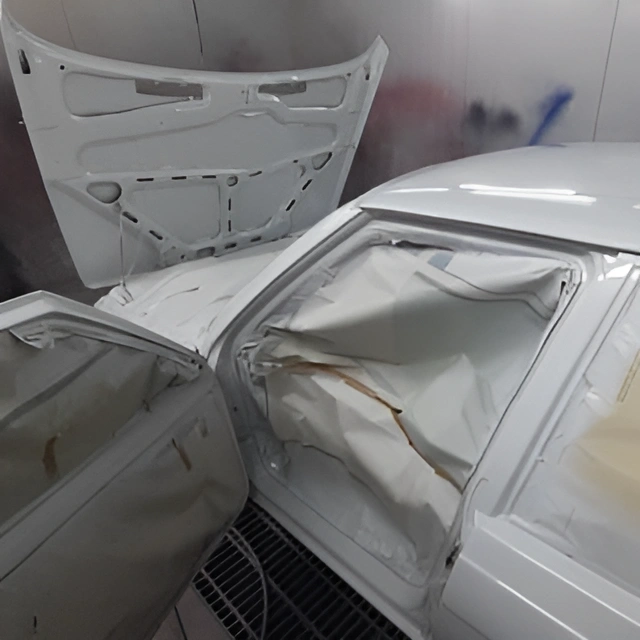
In pearlescent paint application, material quality is just as critical as the technician's spray technique. PPG and Standox paint systems ensure uniform dispersion of mica particles, minimizing the risk of mottling or striping. The dust-free booth environment prevents foreign particles from getting trapped between paint layers.
Why does pearlescent paint color often fail to match?
The main reason for color discrepancies in pearlescent paint is that even the slightest variation in mid-coat thickness, number of coats, or gun distance changes the orientation of the mica pigments and their refraction angle. Even a slight change in spray angle can cause the color to be perceived differently.
Key reasons behind color shade mismatches after panel repairs on pearlescent vehicles include:
- Difference in coat count: Even if the ground color matches perfectly, applying one extra pearl mid-coat makes the color turn yellowish or darker; applying one less coat leaves the luster dull.
- Gun distance and air pressure: Flat mica flakes settle on the surface at different angles depending on air pressure. As the angle of flakes changes, the direction of refracted light shifts, creating a visible shade difference.
- Sun fading: Paint exposed to the sun since leaving the factory naturally lightens. Paint mixed solely to the factory code can look mismatched next to an adjacent sun-faded panel.
- Lack of blending into adjacent panels: Ending paint sharply at panel edges makes shade differences noticeable; therefore, delicate blending into adjacent panels is required.
Warning: Off-the-shelf touch-up pens or pre-mixed aerosol spray cans almost always leave an obvious patch mark on pearlescent colors. Because mica pigment orientation and layer balance cannot be controlled with a spray can, professional blending is essential for deeper scratches.
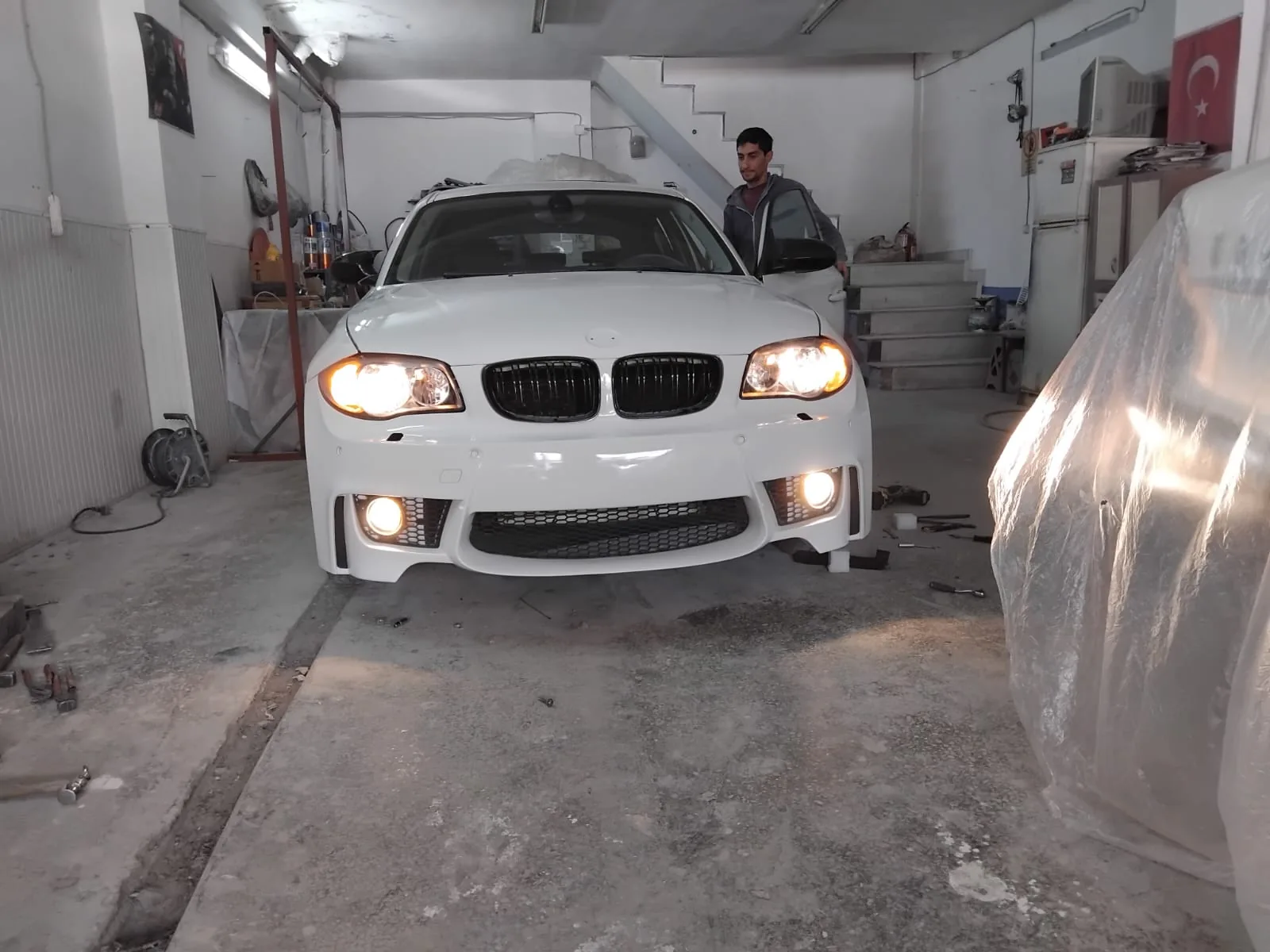
Working with test spray-out cards is essential to achieve a seamless color match. In our workshop, test cards are prepared for every pearlescent vehicle and inspected in daylight, moving on to the car only after an exact match is confirmed.
What influences pearlescent paint prices?
Pearlescent paint prices are generally higher than standard solid colors due to the extra pearlescent layer, specialized mica pigments, test spray-out card process, and blending labor required on adjacent panels. The final cost of the repair depends on panel size, damage condition, and the required labor time.
When researching pearlescent paint prices, keep in mind that cost depends on the type of panel and the extent of damage. With pearlescent paint, even for a single panel, preparing adjacent panels may be necessary for seamless blending. Typical panel-based price ranges at our workshop are as follows:
| Treated Panel | Price Range | Average Duration |
|---|---|---|
| Bumper painting | 2,500–5,000 TL | 1–2 days |
| Door painting | 3,500–6,000 TL | 1–2 days |
| Fender painting | 4,000–7,000 TL | 1–2 days |
| Hood or roof painting | 5,000–10,000 TL | 1–2 days |
| Complete vehicle painting | 25,000–80,000 TL | 5–10 days |
Factors affecting the price when repairing a pearlescent panel include:
- Number of layers and material usage: Because a mica-infused mid-coat is applied over the ground color in pearlescent paint, both paint material volume and application time increase.
- Need for blending into adjacent panels: Clear coating adjacent panels to eliminate edge shade differences adds extra labor.
- Damage and body filler condition: If sheet metal straightening or body filler is required on the panel, the preparation stage takes longer.
- Color complexity: Test card preparation takes more time for pearl whites or multi-angle grey tones.
For our panel painting procedures and detailed pricing criteria, you can review our Antalya panel painting prices guide.
When should you visit a professional workshop?
If a scratch penetrates beyond the clear coat into the pearlescent mid-coat or primer, if obvious shade differences appear between panels in sunlight, or if a panel was replaced after an accident, you should consult a professional workshop. Amateur touch-ups on pearlescent surfaces usually worsen the damage and increase costs.
Common situations where pearlescent car owners consult our workshop include:
- Deep scratches catching a fingernail: Light surface scuffs within the clear coat can be buffed out with machine polishing; but if a fingernail catches, the scratch has penetrated into the pearl coat and requires paint.
- Color shade mismatches spotted on used cars: Panel shade discrepancies not noticed indoors but obvious in daylight can be corrected with professional blending.
- Panel damage from accidents or scrapes: After straightening dents on a fender or door, pearlescent paint must be reapplied in the booth.
- Deciding between spot repair and full panel paint: Whether to perform spot repair painting or paint the entire panel is determined via an assessment based on damage location.
For panel-by-panel repair details, check our Antalya panel painting prices page, and for extensive damage, see our Antalya complete vehicle painting page.
Send a photo of the damage, and we will provide an initial price and time estimate. Workshop inspection/assessment is free.
Maintenance for pearlescent painted vehicles
To maintain the luster and depth of pearlescent paint for years, protect the clear coat from abrasive external factors and harsh chemicals. A habit of regular, gentle washing is the primary prerequisite to prevent clear coat scratches and dulling.
Since mica crystals sit beneath the clear coat, pearlescent depth is lost when the clear coat becomes dull. Therefore, the following maintenance steps are recommended for pearlescent cars:
- Washing method: Gas station brushes leave swirl marks in the clear coat; use pH-neutral shampoo and a microfiber mitt instead.
- Machine polishing timing: Prefer fine swirl-remover polishes instead of heavy compound pastes; unnecessary sanding thins the clear coat layer.
- Bird droppings cleaning: Acidic bird droppings can etch into the clear coat in hot weather and damage the pearl layer; for proper care, check our cleaning bird droppings from car paint article.
- Clear coat peeling risk: If clear coat peels on previously improperly painted panels, the mid-coat may oxidize and darken upon air contact; for repair details, check our clear coat peeling and paint flaking guide.
- Parking in the shade: Keeping the vehicle in the shade helps prevent UV rays from degrading the clear coat and mica particles.
Send a photo of your vehicle, and we will provide an initial price and turnaround time estimate for pearlescent paint. Workshop inspection/assessment is free.
Frequently asked questions
What is the difference between pearlescent paint and metallic paint?
In metallic paint, aluminum flakes reflect light directly to create a single-tone shine. In pearlescent paint, ceramic or mica crystals refract light, causing the color tone to shift depending on the viewing angle. This optical refraction gives pearlescent surfaces deep and rich optical depth.
How many coats are applied for pearlescent paint?
Pearlescent automotive paints are generally applied as a three-stage system. The first coat is the ground base coat, the second coat is a translucent pearlescent mid-coat, and the third coat is the protective clear coat. Although two-stage pearlescent paints occasionally exist on the market, the vast majority of factory OEM colors consist of three layers.
Can spot repair painting be done on pearlescent paint?
Spot repair painting is possible on pearlescent paint, but it requires much more delicate craftsmanship compared to solid colors. Because the thickness and application angle of the pearlescent mid-coat alter the tone, blending into adjacent areas is usually required. The final decision is made after examining the panel and conducting a free inspection/assessment at our workshop; see our Antalya spot repair painting page for details.
Why is pearlescent white paint difficult to color-match?
In pearlescent white, the thickness balance between the underlying white base coat and the pearlescent mid-coat on top is very delicate. If the pearlescent mid-coat is applied too heavily, the surface shifts toward a yellowish or grayish tone; if applied too lightly, the luster disappears. For this reason, an exact match cannot be achieved without digital color matching and test spray-out cards.
Why are pearlescent paint prices higher?
Because an extra pearlescent mid-coat is used in pearlescent paint, material costs and labor time increase. Additionally, preparing and clear coating adjacent panels may be required to achieve seamless color blending. Exact pricing is provided after inspecting a photo of the damaged part or conducting an inspection/assessment at the workshop.
How long does pearlescent painting take?
In our workshop, painting a single panel usually takes 1–2 days, and a complete respray takes 5–10 days. The duration is determined not by curing in the booth, but by surface preparation, color-match test sprays, and delicate flash-off waiting times between coats.
How do I find the color code of a pearlescent painted vehicle?
You can find the vehicle's original color code on the manufacturer label located on the door jamb, under the engine hood, or on the trunk floor. This code, which can also be verified through authorized service records or registration documents, is verified at our workshop using digital color matching to prepare the exact formula.
Related pages
- Antalya panel painting prices
- Antalya complete vehicle painting
- Antalya spot repair painting
- What is oven-baked paint?
- Glossary of car painting terms
Send a photo of your vehicle, and we will provide an initial price and turnaround time estimate for pearlescent paint. Workshop inspection/assessment is free.